
You’ve brought home a kitten. You’re smitten. And the last thing on your mind is worms. Understandable — but intestinal parasites affect a significant proportion of kittens presented to clinics globally, and in Dubai’s subtropical climate, the exposure risk runs year-round. Kittens are especially vulnerable during their first months of life. The good news? Staying on top of parasite treatment for pets in Dubai is straightforward once you know the protocol.
This guide covers when to start, how often to repeat, what the risks are if you skip it, and how to get your kitten’s deworming sorted without the stress.
Key Takeaways
-
Kittens acquire intestinal worms through their mother’s milk, contaminated soil, and environmental exposure — often without showing obvious symptoms.
-
Deworming tablets are administered every three months; there is no preventative product, so regular treatment is the only way to stay on top of reinfection.
-
Dubai’s year-round warmth means parasites remain developmentally active in every season — there is no safe window to skip a dose.
-
Some intestinal worms are zoonotic, posing a genuine risk to children in the household; regular deworming protects the whole family.
-
Deworming is part of a complete kitten wellness plan that also includes core vaccinations, rabies vaccination, microchipping, and Dubai Municipality registration.
-
You can book parasite treatment at the Al Furjan clinic, the City Walk clinic, or as a home visit — whichever suits your kitten best.
Why Kittens Need Deworming: Understanding Parasite Transmission
Kittens can acquire intestinal worms in utero or through nursing, meaning parasites pass directly from the mother cat through her milk. Once a kitten begins exploring its environment and grooming itself, the opportunities for reinfection multiply through contaminated soil, prey items, and shared surfaces.
Common culprits include Toxocara cati (roundworms), Dipylidium caninum (tapeworms), and Ancylostoma species (hookworms). In practice, you won’t always see clinical signs — vomiting, diarrhoea, or a pot-bellied appearance. Many kittens carry a significant parasite burden without displaying obvious illness, which is exactly why a scheduled deworming plan matters more than waiting for symptoms.
The Zoonotic Risk: Parasite Treatment Protects Your Whole Family
Some intestinal worms are zoonotic — they can transfer from your kitten to humans. Toxocara species pose a genuine concern, particularly for young children, who are more likely to have hand-to-mouth contact after touching pets. Regular parasite treatment for pets in Dubai isn’t just about your kitten’s health. It’s a household protection strategy.
According to the World Health Organization, soil-transmitted helminths affect hundreds of millions of people globally, with children bearing the highest burden. Keeping your kitten dewormed is one straightforward line of defence at home.
When to Start: The Dubai Kitten Wellness Timeline
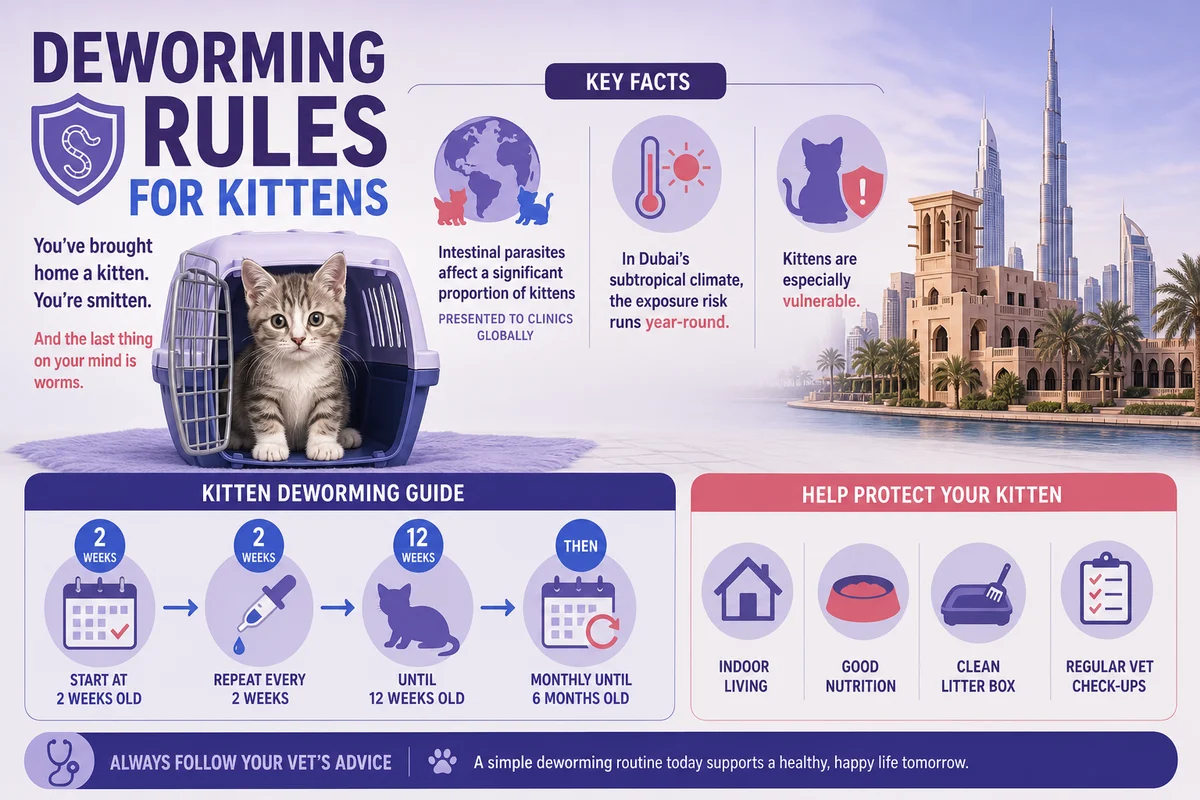
If your kitten is eight weeks or older, they’re ready to begin their full wellness schedule. Kittens under eight weeks should remain at home, away from other animals, until they reach vaccination age and can be safely examined by a veterinarian.
At that first appointment, your vet will assess weight, age, general condition, and parasite exposure risk, then map out an individualised protocol. Parasite treatment isn’t handled as a standalone procedure — it’s integrated into the complete first-visit plan alongside core PCH vaccination, rabies vaccination, microchipping, and Dubai Municipality registration.
What the Full Schedule Looks Like
Vaccinations follow a two- or three-visit schedule at approximately four-week intervals, depending on your kitten’s exact age at first presentation. Protocols follow the most current WSAVA (World Small Animal Veterinary Association) recommendations — the pet equivalent of WHO guidelines. Deworming is administered as part of this package, then repeated every three months throughout your cat’s life.
How Often Does Your Kitten Need Deworming?
The answer follows evidence-based practice: every three months.
Deworming tablets target any intestinal parasites your kitten has acquired in the preceding three-month window. Here’s the critical distinction: there is no true preventative deworming product. These medications work through direct action on parasites already present — they do not create a protective barrier against future infection.
Think of it as a quarterly reset. You eliminate what’s present, and three months later you repeat the cycle to catch any newly acquired infections. It’s clean, simple, and effective.
Why One Treatment Is Never Enough
First-time cat parents sometimes assume one round is sufficient. It isn’t. Reinfection can occur within days of treatment through environmental exposure. In a city like Dubai, where temperatures remain warm year-round and parasites stay developmentally active in every season, quarterly deworming is the only way to maintain consistent protection.
Set a calendar reminder or use the PetsFirst app — available on the App Store and Google Play at petsfirst.ae — so you never miss a dose.
Dubai’s Climate and Year-Round Parasite Risk
Dubai’s heat directly influences parasite epidemiology. Unlike temperate climates where transmission drops during winter, Dubai’s sustained warmth means parasites remain in their optimal developmental window throughout the year. Toxocara ova can embryonate in soil within weeks; tapeworms face no seasonal suppression whatsoever.
Skipping a round because “it’s not peak season” doesn’t apply here. There is no off-season for parasite treatment for pets in Dubai.
External Parasites: A Complementary Strategy
Deworming handles internal parasites. Your kitten may also be exposed to external parasites — fleas, ticks, and ear mites — which require separate treatment. Multiple product formats are available, including spot-on solutions and oral tablets, with treatment intervals of either four weeks or three months depending on the product.
Year-round tick treatment is particularly important in Dubai’s warm climate, as ticks can transmit Ehrlichia and remain active in every season. Your vet will recommend the right ectoparasite strategy during consultation.
How Deworming Works: Active Ingredients and Mechanism
Deworming for kittens uses oral tablets administered either in-clinic or at home under veterinary guidance. Active ingredients vary by formulation:
-
Fenbendazole targets roundworms and hookworms via microtubule disruption
-
Pyrantel pamoate paralyses roundworms and hookworms through nicotinic ganglionic blockade
-
Praziquantel disrupts tegumental integrity in tapeworms
The medication eliminates parasites present in your kitten’s gastrointestinal tract at the time of administration. Because it provides no ongoing protection, the three-month repeat interval is non-negotiable. The process is quick and generally well-tolerated — most kittens show no adverse reaction.
How to Book Parasite Treatment for Pets in Dubai
You have several options depending on your location and your kitten’s temperament.
If you’re near Al Furjan, you can book your kitten’s deworming at the Al Furjan clinic directly online. Both clinic locations are fully equipped with the appropriate pharmaceuticals and trained staff to administer deworming as part of your kitten’s complete parasite management plan.
Not keen on the car journey with an anxious kitten? A home deworming service is available if you’d rather have the vet come to you. Your kitten stays in a familiar, low-stress environment — no carrier anxiety, no waiting room exposure. This approach often results in better compliance for anxiety-prone cats.
Deworming as Part of Your Kitten’s Complete Preventive Care Plan
Parasite treatment doesn’t exist in isolation. It’s one component of a structured preventive care plan every kitten in Dubai requires.
Alongside quarterly deworming, your kitten needs:
-
PCH vaccination — core protection against feline infectious diseases, administered at the first visit and annually thereafter
-
Rabies vaccination — mandatory by Dubai law, administered at the appropriate age and repeated annually
-
Microchipping — a legal requirement in Dubai, performed once for permanent lifetime identification
-
Dubai Municipality registration — required following rabies vaccination, with annual renewal thereafter
Once established, the rhythm becomes routine. Primary vaccinations and microchipping happen during the first few visits; registration follows rabies vaccination; deworming repeats every three months. Annual boosters and re-registration slot in predictably each year.
Frequently Asked Questions
Q: When should I start deworming my kitten in Dubai?
A: Kittens can begin their full wellness schedule, including deworming, from eight weeks of age. Younger kittens should remain at home until they reach this threshold. Your vet will confirm the right starting point and build an individualised protocol at the first appointment.
Q: How often does my kitten need to be dewormed?
A: Every three months, throughout your cat’s life. Deworming tablets treat parasites acquired in the preceding three-month window, so regular repetition is the only way to stay protected. There is no preventative product that provides ongoing cover between doses.
Q: Can my kitten pass worms to me or my children?
A: Yes — some intestinal worms, particularly Toxocara species, are zoonotic and can transfer to humans. Children are at higher risk due to hand-to-mouth contact after touching pets. Regular deworming significantly reduces this household transmission risk.
Q: Does Dubai’s climate make deworming more important?
A: Absolutely. Dubai’s warm temperatures mean parasites remain developmentally active year-round — there is no winter slowdown in transmission. Quarterly deworming is epidemiologically necessary in this region, not just a general guideline.
Q: Is deworming included in the kitten vaccination package?
A: Yes. Deworming is included in the kitten vaccination package alongside the full vaccination schedule, microchip implantation, rabies vaccination, and pet passport. There is no additional charge for a third vaccination visit if your kitten’s age requires it.
Q: Can I have my kitten dewormed at home instead of at a clinic?
A: Yes. A home deworming service is available, with a vet visiting your home directly. This is a practical option for kittens that experience travel or clinic anxiety, and keeps the experience calm and stress-free.
Q: What other parasite treatments does my kitten need beyond deworming?
A: Deworming covers internal parasites only. Your kitten may also need treatment for external parasites such as fleas, ticks, and ear mites, using spot-on solutions or oral tablets on a four-week or three-month schedule. Your vet will recommend the right products based on your kitten’s lifestyle and exposure risk.
The Bottom Line: Make Parasite Treatment a Habit, Not an Afterthought
Deworming your kitten every three months is one of the most important things you can do as a new cat parent in Dubai. It protects your kitten’s growth and development, shields your family from zoonotic risk, and fits easily into a routine once the schedule is established.
Don’t wait for clinical signs. Don’t assume one treatment is enough. Don’t let the quarterly window slip — especially in a climate where parasites remain active in every season.
Book your kitten’s deworming at the Al Furjan clinic, at City Walk, or as a home visit — whichever works best for you and your kitten. Parasite treatment for pets in Dubai is just a few clicks away.